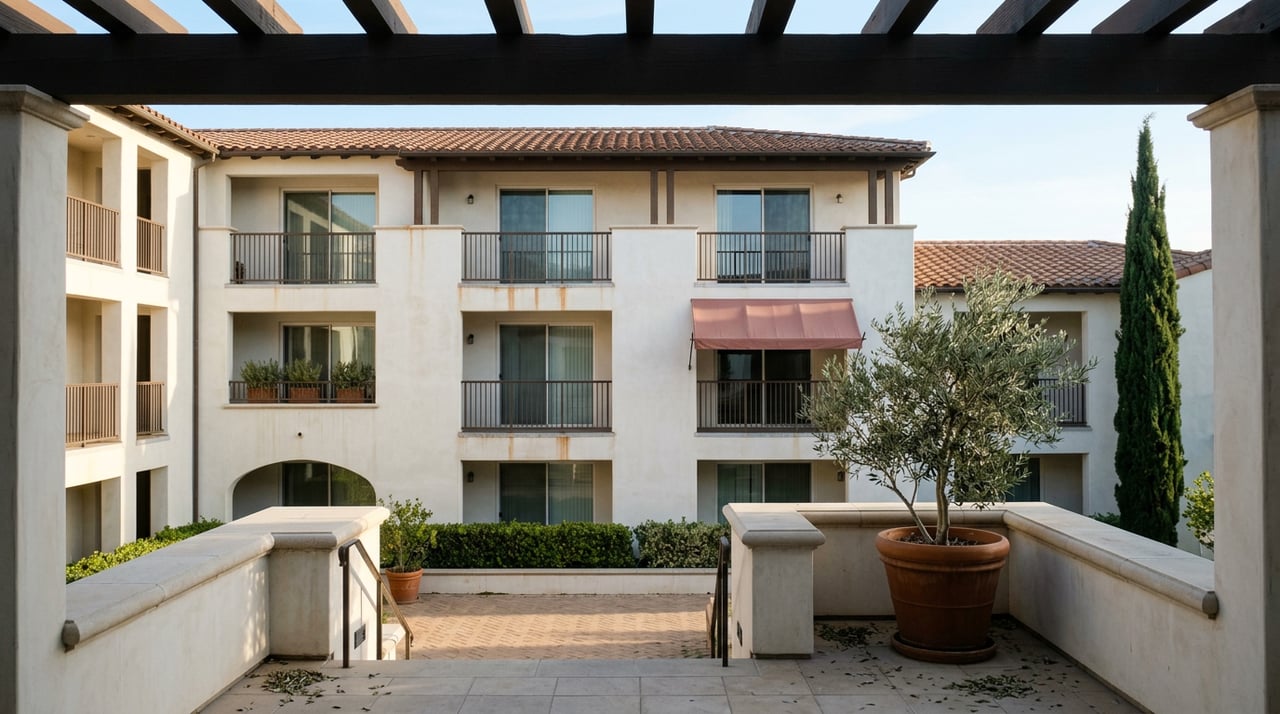
A buyer who has done the homework walks into Walnut Creek already knowing the number. A median sale price near $997,000 for the three months ending June 2026, up 19.1 percent year over year. Homes moving in about 18 days. Multiple offers as the norm rather than the exception. What that buyer usually does not know is that the number describes at least three transactions that behave nothing alike, and the gap between them is not cosmetic. It is the difference between a conforming loan and a jumbo, and in one case, the difference between a mortgage and no mortgage at all.
Walnut Creek is not one housing market wearing one price tag. It is a citywide median built from a 55-and-over community with its own governance structure, a cluster of dense downtown condos priced for walkability, and hillside single-family neighborhoods that individually run well past a million dollars. Blend those together and the monthly median will swing based on nothing more than which segment happened to close escrow that month. Understanding which of the three you are actually shopping, or selling, in matters more than the headline figure ever will.
The line that splits every single-family buyer in two
Start with the number that does the most quiet damage to a buyer's plan: the 2026 conforming loan limit for Contra Costa County, set at $1,249,125 for a one-unit property, with a lower "baseline" limit of $832,750 for buyers whose loan amount fits under it. Contra Costa is one of ten California counties sitting at the national high-cost ceiling, alongside Alameda, Los Angeles, Marin, and San Francisco, because median home values here run well above the national baseline.
| Loan tier | 2026 limit (1-unit) | What it means for the buyer |
|---|---|---|
| Baseline conforming | $832,750 | Lower rate, easier qualifying, as little as 3 to 5 percent down |
| High-balance conforming | Up to $1,249,125 | Still Fannie Mae or Freddie Mac eligible, slightly tighter pricing, 5 percent down possible |
| Jumbo | Above $1,249,125 | Lender's own underwriting, typically 700-plus credit, 10 to 20 percent down, larger reserves |
Almost every mainstream single-family home in Walnut Creek prices at or above that $1,249,125 ceiling once you're outside the smallest, oldest housing stock. That means a buyer comparing two listings $50,000 apart on a portal search is often comparing a high-balance conforming loan to a jumbo loan, two different underwriting files with different documentation, different reserve requirements, and different closing timelines. The monthly payment difference between the two is usually smaller than buyers expect. The qualification difference is not, and it is the reason a well-prepared offer clears escrow while a comparable one stalls in underwriting.
Why Rossmoor doesn't play by any of those rules
Roughly 6,700 units and nearly 10,000 residents sit inside Rossmoor, the 55-and-over community spread across 1,800 acres in the Tice Valley area of Walnut Creek. It has 27 holes of golf, five clubhouses, and more than 200 clubs, which is the part every buyer hears about first. What they hear about second, usually from a lender partway through escrow, is that Rossmoor is not one housing market either.
The community is organized into 23 separate homeowners associations called Mutuals, each governed under California's Davis-Stirling Act, each running its own board and reserve fund. Within that structure sit three genuinely different forms of ownership:
- Co-ops, where the buyer purchases shares in a corporation that owns the building and land, financed through a specialized share loan rather than a traditional mortgage
- Condominiums, individually deeded units that can be financed through a conventional lender of the buyer's choosing
- Detached single-family homes, which carry their own maintenance and insurance structure separate from the shared Mutual system
The financing gap between these is not a technicality. A co-op purchase cannot use a standard mortgage because the buyer is acquiring an equity position in a corporation, not a deed to real property, so the loan has to be a share loan from one of the smaller pool of lenders that offer that product. Layer onto that a fact most Rossmoor listings won't mention up front: the community's insurance coverage dropped below the threshold Fannie Mae and Freddie Mac require in early 2024, tied to wildfire-related impacts on insurance markets across California, which pushed much of Rossmoor into a non-warrantable designation. Non-warrantable means standard conforming financing is off the table entirely, and buyers are left choosing between cash, hard money, or a lender who has built a specific workaround for exactly this situation.
Add the one-time cost that applies regardless of financing path. Rossmoor's Membership Transfer Fee, paid at closing, rose to $18,000 as of April 2026. A buyer pricing out a $700,000 Rossmoor purchase against a $700,000 downtown condo is not comparing two versions of the same transaction. One closes like a conventional deal. The other requires a lender who already knows the community, a financing product most banks don't stock, and a five-figure fee the citywide median never accounts for.
What the downtown premium is actually paying for
Move three miles and the market behaves completely differently again. Downtown Walnut Creek's condo median sale price ran $845,000 in March 2026, down 10.6 percent from the year before, which on its own reads like a softening segment. But the price per square foot tells the opposite story: $632 per square foot downtown in March 2026, up 16 percent year over year, against roughly $581 per square foot citywide as of July 2026.
A falling median with a rising price per square foot usually means one thing: smaller units are dominating the sales mix, and buyers are paying more for less space in exchange for something the square footage doesn't capture. In downtown Walnut Creek that something is walkable access to Broadway Plaza and proximity to BART, the kind of premium that holds even when a single anchor storefront sits vacant or a well-known restaurant chain closes a location nearby. The lesson for a buyer or seller isn't that downtown condos are overpriced or underpriced. It's that the per-unit price and the per-square-foot price are answering two different questions, and a seller pricing a downtown listing off the citywide median alone is very likely leaving money on the table or scaring off buyers with a number that doesn't match the comps that actually matter.
Ordinary HOA dues add another layer worth pricing in before an offer goes out. Condo and townhome dues elsewhere in Walnut Creek typically run $300 to $700 or more a month depending on the building, while Rossmoor's monthly coupon tends to sit higher because it bundles in amenities, exterior maintenance, and in the co-ops, even property taxes. Comparing two units by list price alone, without pulling the HOA statement, is comparing incomplete numbers.
Reading the median without getting fooled by it
None of this means the citywide median is useless. It means the median is a starting point for a conversation, not the conversation itself. A buyer or seller who wants a number that actually predicts their financing path, their closing timeline, and their true monthly cost needs to know which of Walnut Creek's segments they're standing in before the first offer goes out or the first listing goes live. The buyer shopping a $1.2 million single-family home needs to know they're on the edge of the conforming ceiling. The buyer touring a Rossmoor co-op needs to know their financing conversation starts in a different place entirely. The seller listing a downtown condo needs pricing built on the per-square-foot comps in that specific building cluster, not a blended citywide number that has nothing to do with their unit.
Frequently asked questions
Does non-warrantable financing mean a Rossmoor property is a bad investment? No. It means the financing path is narrower. Cash buyers and buyers working with a lender who already offers Rossmoor-specific share loans or non-warrantable products can still close, but a buyer walking in expecting a standard 30-year conventional mortgage will need to adjust that plan early, not mid-escrow.
Will the $1,249,125 conforming ceiling change again next year? The Federal Housing Finance Agency recalculates these limits annually based on national and local home price trends, so the number has moved upward in recent years and is expected to be revisited again for 2027. Buyers planning a purchase that sits near the current line should confirm the figure at the time they apply rather than relying on last year's number.
Why would a seller price a downtown condo differently than the citywide median suggests? Because the citywide median blends unit sizes, building types, and neighborhoods that don't share a pricing logic. A downtown one-bedroom and a Northgate estate can both close in the same month and both feed the same median, even though neither one is a meaningful comp for the other.
If you're weighing a purchase, a sale, or a move between one of these Walnut Creek segments and want a clear read on which market your situation actually falls into, Ann Newton Cane can walk you through the specifics before you write an offer or set a list price. Request a Confidential Home Valuation to start that conversation.